Mobile Phone Technology
5G Mobile Network Architecture
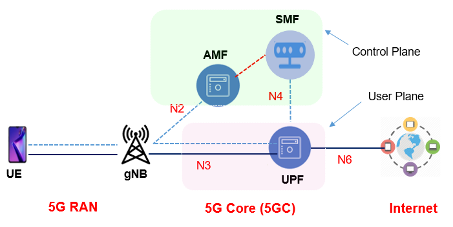
image ©tucanaThere are 2 variants of 5G in the Uk; 5G-SA (Stand Alone) and 5G-NR (New Radio). 5G-NR has the 5G radio / wireless infrastructure but it is connected to the 4G core to send the data to the Internet. 5G-SA is the full end to end 5G which includes a new core to the network.
The User Equipment (UE) will connect wirelessly to a mast. This includes all the technology to manage the equipment connected to the mast itself, and to pass on the data to the core network. The device is the next generation NodeB (gNb).
The core of the 5G network (realised in 5G-SA) is split into 2 planes, the user plane (UP) and the control plane (CP)
The user plane is the part of the core that connects the UE to the Internet. This is managed by a UPF (User Plane Function) that is distributed between an edge location and a centre location. This is in an attempt to speed up the network, and lower the latency. Whenever possible the edge will manage the UPF functions thus distributing the tasks putting them nearer the user where possible, connecting to an edge data centre.
There are two aspects to the Control Plane; firstly the AMF (Access and Mobility Management Function). The AMF manages the access to the network, authenticating the UE and access to the 5G network. To allow the AMF to do it's task it needs access to the necessary data. In 5G-SA this is contained in a UDR (Unified Data Repository). This will be a distributed data store, accessed via various APIs to facilitate the distribution and access. The data can be moved to the edge to again speed up the functions of the AMF.
The SMF manages the data sessions for the UE whilst on the 5G network. Interfaces with the User Plane that manages the data transfer.
We may have started to use our mobile phones to make phone calls but now these devices are key to our modern society. We use our mobile phones for directions in a strange city; to access our money through our banking and credit card apps; for tickets to travel whether that is bus, train or air; tow watch videos; to take images and buy stuff.
To allow all these applications we need a robust mobile network. mpt-5g.co.uk seeks to provide information about the technology behind the mobile phone in order to aid understanding and promote more realistic discussions about the technology. Understanding some of the basics of mobile phone technology will help explain how things work and what can and cannot be done with mobile phone technology.
mpt-5g.co.uk is a FREE online resource. Have you found it interesting? You can say thank you and buy me a coffee here. Thank you very much.
w : mpt-5g.co.uk
e :
 Blog
Blog
© mobilephonetechnology.co.uk all rights reserved 2017-2025