Mobile Phone Technology
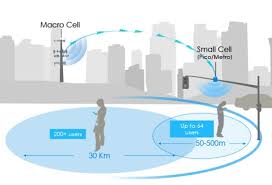
5g small and macro cells
image ©5G Hub Technology inc.The classical view of mobile phone transmission is for large (macro) cells to be erected to cover a significant area (100 sq. km.) and we use these with our phones. Each of these macro cells has a capacity and if this capacity is limiting consumer experience one solution is to build another macro cell in the area. Building macro cells is difficult from a planning viewpoint and cost. Often the requirement is for more localised network capacity in areas such as high streets, shopping malls, sports stadia or music festivals.
One solution is to build and install small cells. These small cells are the size of a shoe box and can be mounted on street furniture such as lamp posts - hence the term smart lamp posts. These small cells will provide both 4G and 5G coverage over small areas using mid-range frequencies [3.4GHz to 3.8GHz for 5G] and will be tuned to cover the small target area. These small cells will invoke more call handovers but if the customer is walking, or stationary, this will not be a problem. These cells do need a backhaul to the core network. They can connect back to the nearest macro tower, connect to another small cell and hence back to the macro cell. Whilst mobile phone technology to crate the backhaul; they could use some other form of radio frequency such as microwaves or Ulta Wide communications; or could capture a passing fibre cable.
Small cells will come more into their own when the UK releases the 26GHz waves for mobile phone technology, the mmWaves. These will have a much greater capacity than the 3.4GHz to 3.8GHz waves, and can be put to use in the areas that need added capacity.
We may have started to use our mobile phones to make phone calls but now these devices are key to our modern society. We use our mobile phones for directions in a strange city; to access our money through our banking and credit card apps; for tickets to travel whether that is bus, train or air; tow watch videos; to take images and buy stuff.
To allow all these applications we need a robust mobile network. mpt-5g.co.uk seeks to provide information about the technology behind the mobile phone in order to aid understanding and promote more realistic discussions about the technology. Understanding some of the basics of mobile phone technology will help explain how things work and what can and cannot be done with mobile phone technology.
mpt-5g.co.uk is a FREE online resource. Have you found it interesting? You can say thank you and buy me a coffee here. Thank you very much.
w : mpt-5g.co.uk
e :
 Blog
Blog
© mobilephonetechnology.co.uk all rights reserved 2017-2025