Mobile Phone Technology
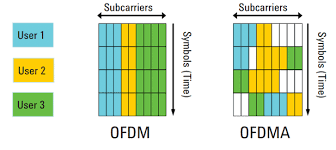
Frequency and time graphs in OFDM and OFDMA.
image ©ResearchGateOFDM is the 'raw' frequency division multiplexing in that it splits splits the spectrum into 15kHz sub-channels, orthogonally. In this form it means that the whole of the sub-channel is allocated to a single user. This can cause issues with efficiency and fairness. What if the sub-channel could be shared between different users over a single timeslots. This is OFDMA.
Time Division Multiplexing (or Time Division Duplex) will split the available frequency space into time-slices, and different users will be allocated a timeslice to send their data, then have to wait their turn for the next timeslice
OFDMA uses OFDM as the base technology and add in TDM meaning the available space to send the data is split by both frequency and time, as shown in the diagram. By using OFDM rather than simple FDM as the base frequency division technology more data cn be sent. Also OFDMA is a fairer and efficient technology to send data. On top of OFDMA will be a modulation scheme such as 64QAM.
In LTE+ the sub-channels are 15kHz wide and allocated in 12 sub-channel resource blocks.The time-slice is 1ms.
In 5G there can be different sub-channel sizes, these sizes and related channel size are determined by the numerology parameter (µ), as shown in the table. Not that only the first two lines (µ = 0 or 1) can be used with FR1 frequencies (sub 6GHz), whereas mmWaves can potentially use all of these combinations. Also the sub-channels are not allocated individually, but in resource blocks of 12 sub-channels
| µ | Sub-channel size | Resource block (12 sub-carriers) | FR1 or FR2 | |
|---|---|---|---|---|
| 0 | 15kHz | 180kHz | FR1 | 1ms |
| 1 | 30kHz | 360kHz | FR1 | 0.5ms |
| 2 | 60kHz | 720kHz | FR2 | 0.25ms |
| 3 | 120kHz | 1440kHz | FR2 | 0.125ms |
| 4 | 240kHz | 2880kHz | FR2 | 0.0625ms |
Note OFDMA is used in WiFGi6 as well as LTE+ / 5G
We may have started to use our mobile phones to make phone calls but now these devices are key to our modern society. We use our mobile phones for directions in a strange city; to access our money through our banking and credit card apps; for tickets to travel whether that is bus, train or air; tow watch videos; to take images and buy stuff.
To allow all these applications we need a robust mobile network. mpt-5g.co.uk seeks to provide information about the technology behind the mobile phone in order to aid understanding and promote more realistic discussions about the technology. Understanding some of the basics of mobile phone technology will help explain how things work and what can and cannot be done with mobile phone technology.
mpt-5g.co.uk is a FREE online resource. Have you found it interesting? You can say thank you and buy me a coffee here. Thank you very much.
w : mpt-5g.co.uk
e :
 Blog
Blog
© mobilephonetechnology.co.uk all rights reserved 2017-2025