Mobile Phone Technology
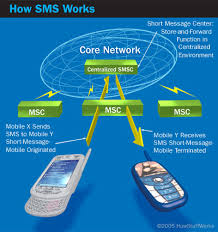 image ©computer.howstuffworks.com
SMS is the Short Messaging System available on all mobile phones. An app on a user's phone will allow them to send and receive SMS messages. An SMS message is limited to 1120 bits which will be coded to 160 7-bit characters or 140 8-bit characters. Thus SMS is a basic messaging system.
SMS was a key feature of 2G phones with the first SMS was sent in the UK by a Vodafone engineer on 3rd December 1992. It said 'Happy Christmas'.
The customer SMS service grew out of the system used by service engineers to communicate with each other. But the MNOs soon realised this was a feature that would be useful to customers and could be used to make them money. At the start each SMS message was charged a rate of 10p per message. Later SMS messages were bundled into contracts and now unlimited messages are included in all but the most basic customer package.
The SMS message is sent over the control channel and not over the data network. The control channel manages the phone and devices on the network, and it is through this control channel that messages are sent. As the strength of a signal degenerates with distance from the antenna, the data (HTTP connections) services are lost first. Then the phone connection can become crackly and then lost leaving the SMS system as the most reliable in area of poor or very little connection.
When data is sent over HTTP it is the client that requests the data, a pull technology. SMS is different, it uses a push technology. The SMS message can be sent at any time, it does not rely on the recipient being online. These SMS messages are then pushed to the recipient's phone from the SMSC (Short Messaging Service Centre), rather than the recipient having to look for messages. These SMS messages are fundamentally different from other messaging systems.
Sending an SMS
- Sender creates the SMS message within an App on the phone
- The App sends the message to the SMSC (Short Message Switching Centre) via the control channel. Within the settings of a phone there will be the phone number of the local network SMSC.
- The message is stored within the SMSC which then finds the recipient.
- If the receiver is on the same network as the sender, the message is then sent to the reciever
- If the receiving phone is on another network, the SMSC forwards the message to that network's SMSC for this network to store and forward the message to the recipient
- Tracking is possible for SMS messages. The sender will know that the recipient has received the message.
In these days of 4G / 5G SMS is seen as an old and outdated technology, in most phone systems it has been overtaken by RCS messaging systems. But RCS systems default to SMS if the RCS app has difficulty in sending the message. WhatsApp and iMessage are other very popular messaging systems; but these are sent as data and will not work when there is poor data connections whereas SMS can work. SMS are still used by many organisations to remind the customer of an appointment, to inform the customer of outages in key services and other business applications. These are powered by bulk SMS providers. Sadly SMS messages are also used to scam phone users, just as email is.
We may have started to use our mobile phones to make phone calls but now these devices are key to our modern society. We use our mobile phones for directions in a strange city; to access our money through our banking and credit card apps; for tickets to travel whether that is bus, train or air; tow watch videos; to take images and buy stuff.
To allow all these applications we need a robust mobile network. mpt-5g.co.uk seeks to provide information about the technology behind the mobile phone in order to aid understanding and promote more realistic discussions about the technology. Understanding some of the basics of mobile phone technology will help explain how things work and what can and cannot be done with mobile phone technology.
mpt-5g.co.uk is a FREE online resource. Have you found it interesting? You can say thank you and buy me a coffee here. Thank you very much.
w : mpt-5g.co.uk
e :
 Blog
Blog
© mobilephonetechnology.co.uk all rights reserved 2017-2025