Mobile Phone Technology
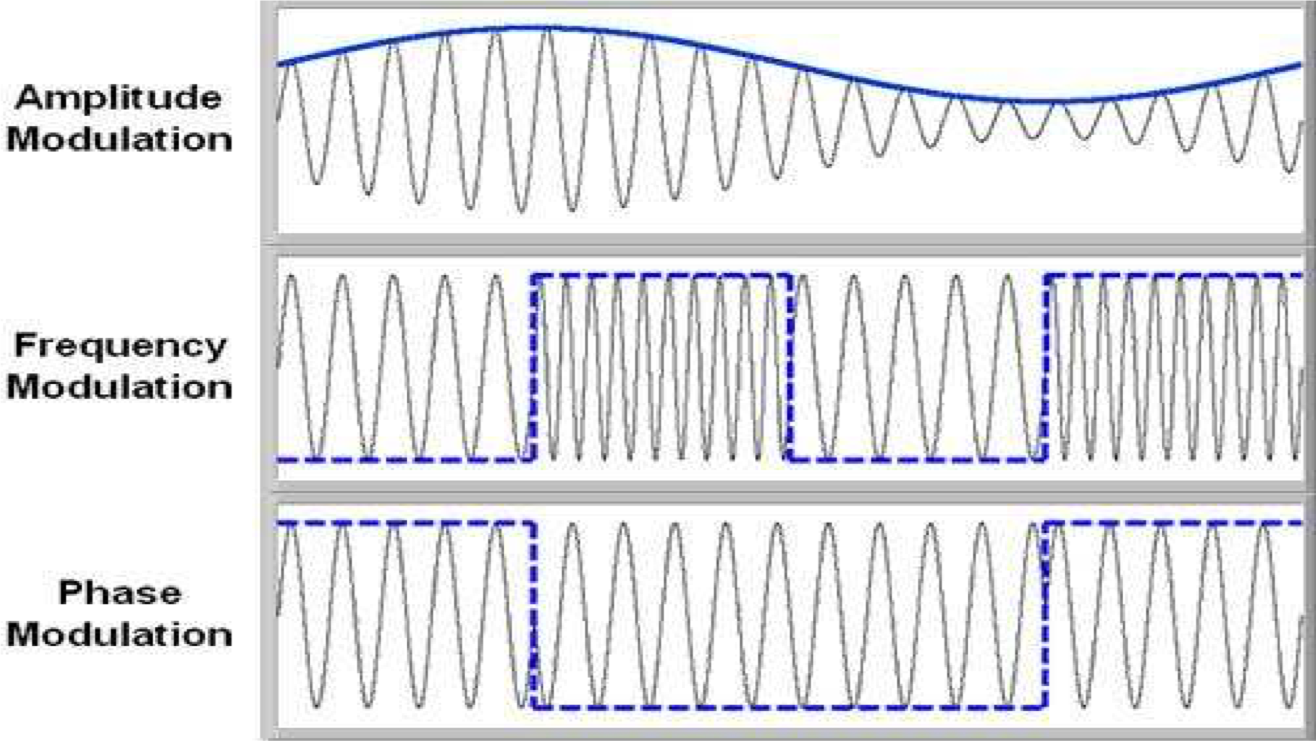
The 3 methods of modulation
The data, in terms of 0's and 1's needs to be sent on a carrier wave at a specific frequency. For example Vodafone use their frequencies at 900MHz to send their 4G data. To achieve the sending of the data, a characteristic of the carrier wave needs to be altered in order to distinguish the 0 form a 1. There are 3 characteristics that can be altered namely the amplitude, frequency and the phase.
Amplitude Modulation: The carrier wave is sent with two different amplitudes, one represents the 0 and another the 1. In the most basic form, amplitude modulation involves one wave at one amplitude for a 0 and another amplitude to represent a 1.
Frequency Modulation: The carrier wave is sent with two different different frequencies, one represents the 0 and another the 1. These different frequencies need to be within the band of the carrier wave and hence the changes in frequency will be small, and difficult for the receiver to detect.
Phase Modulation: The third feature of the wave that can be changed is the phase of the wave. In it's simplest form one phase would be a 0 and a 180 degree phase change would represent a 1. This is BPSK (Binary Phase Shift Keying). It turns out that phase modulation is easier for the receiver to decode the data, as 90 degree (and smaller phase changes) are easy for the receiver to decode.
Looking for more bits per wave: To achieve more data per wavelength modulation schemed more complex that the three discussed are needed. We can have more than two amplitudes, more than two phases, to get more complex modulation for sending more than 1 bit per wave. OFDM and OFDMA are used that use a combination of phase and amplitude modulation to sent up to 64 bits per wave.It turns out that frequency modulation is difficult to scale.
We may have started to use our mobile phones to make phone calls but now these devices are key to our modern society. We use our mobile phones for directions in a strange city; to access our money through our banking and credit card apps; for tickets to travel whether that is bus, train or air; tow watch videos; to take images and buy stuff.
To allow all these applications we need a robust mobile network. mpt-5g.co.uk seeks to provide information about the technology behind the mobile phone in order to aid understanding and promote more realistic discussions about the technology. Understanding some of the basics of mobile phone technology will help explain how things work and what can and cannot be done with mobile phone technology.
mpt-5g.co.uk is a FREE online resource. Have you found it interesting? You can say thank you and buy me a coffee here. Thank you very much.
w : mpt-5g.co.uk
e :
 Blog
Blog
© mobilephonetechnology.co.uk all rights reserved 2017-2025