Mobile Phone Technology
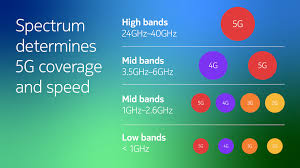
Different frequencies used in 5G
image ©nokiaThere are 3 types of frequency used (or about to be used) for the delivery of 5G in the UK - low, mid and high bands. Each has their own characteristics defined by the basic equation from physics:
c = f λ
(speed of light) = (frequency) * (wavelength)
This means that the higher the frequency the shorter the wavelength. These shorter wavelengths will travel a shorter distance and will not penetrate buildings, but on the other hand the associated higher frequency can deliver more data capacity. Thus the frequencies are used for different purposes
Low Band Waves: which in 5G terms is the 700MHz waves. These waves are used to provide coverage over large geographic areas with a coverage of around 3.5km from each mast. These have similar qualities to the 800MHz or 900MHz waves used in 4G and 2G networks. The 70MHz waves provide a background coverage but this is neither super fast nor the capacity to deliver the 5G demand in highly populated areas.
Mid Band Waves : these are designed to add capacity in our towns and cities where there is heavy demand. In 5G the frequencies are in the 3.4GHz to 3.8GHz range. Typically these waves will be able to travel up to 1km from the mast and can deliver 5 times the capacity of the low band waves.
High Band Waves : [In the UK licenses for these waves will only be release in early 2026]. These are the so called mmWaves in the 26GHz range. The downside of these waves is that they will only be able to travel 100m-200m but the capacity will be 15-30 times that of the low band waves. This leads to these waves being used for very specific applications. They will be used in Sports arenas, shopping malls etc where there is a very high number of customers, as well in novel applications requiring high data demand. They will also be used in industrial applications.
| 5G Spectrum Bands. | ||||
|---|---|---|---|---|
| low band | mid band | high band | Also Use | |
| EE | 700 | 3.4GHz, 3.6GHz | - | 1800Mhz, 2100MHz, 2600Mhz |
| O2 | 700MHz | 3.4GHz, 3.6GHz. | - | 1800MHz 2100MHz |
| Three | 700MHz | 3.4GHz, 3.6GHz. | - | 15000MHz |
| Vodafone | 900MHz | 3.4GHz, 3.6GHz. | - | 2100MHz |
We may have started to use our mobile phones to make phone calls but now these devices are key to our modern society. We use our mobile phones for directions in a strange city; to access our money through our banking and credit card apps; for tickets to travel whether that is bus, train or air; tow watch videos; to take images and buy stuff.
To allow all these applications we need a robust mobile network. mpt-5g.co.uk seeks to provide information about the technology behind the mobile phone in order to aid understanding and promote more realistic discussions about the technology. Understanding some of the basics of mobile phone technology will help explain how things work and what can and cannot be done with mobile phone technology.
mpt-5g.co.uk is a FREE online resource. Have you found it interesting? You can say thank you and buy me a coffee here. Thank you very much.
w : mpt-5g.co.uk
e :
 Blog
Blog
© mobilephonetechnology.co.uk all rights reserved 2017-2025